
Revenue predictability is one of the quiet problems that many Nigerian businesses continue to manage manually. A customer signs up for a loan, insurance policy, rent contribution, subscription, savings plan, utility payment or service contract, but the actual collection process still depends on reminders, follow-ups, failed card attempts, manual transfers, reconciliation gaps and customer availability at the point payment is due.
For businesses that depend on recurring income, this creates a fragile operating model. The product may be good, the customer may have agreed to pay, and the business may have already delivered value, yet collection still becomes uncertain. That uncertainty is what structured direct debit management is designed to solve.
Why Recurring Payments Need Better Infrastructure
Cards have played an important role in digital payment adoption, but they are not always the strongest foundation for recurring collections. Cards expire, get replaced, fail because of issuer restrictions, hit transaction limits or require customer action at the point a scheduled payment is due. In many cases, the business only discovers the problem when the payment fails.
For one-off purchases, that may be manageable. For recurring collections, it becomes operationally expensive because a failed repayment, premium, subscription or bill payment is not just a failed transaction. It creates customer support work, collection follow-up, reconciliation pressure, cashflow uncertainty and, in credit-led businesses, direct exposure to repayment risk.
Direct debit changes the collection logic by moving the relationship from repeated payment attempts to mandate-based authorisation. Once the customer gives consent, the business can collect from the customer’s bank account based on the approved mandate structure, subject to the agreed amount, frequency and rules.
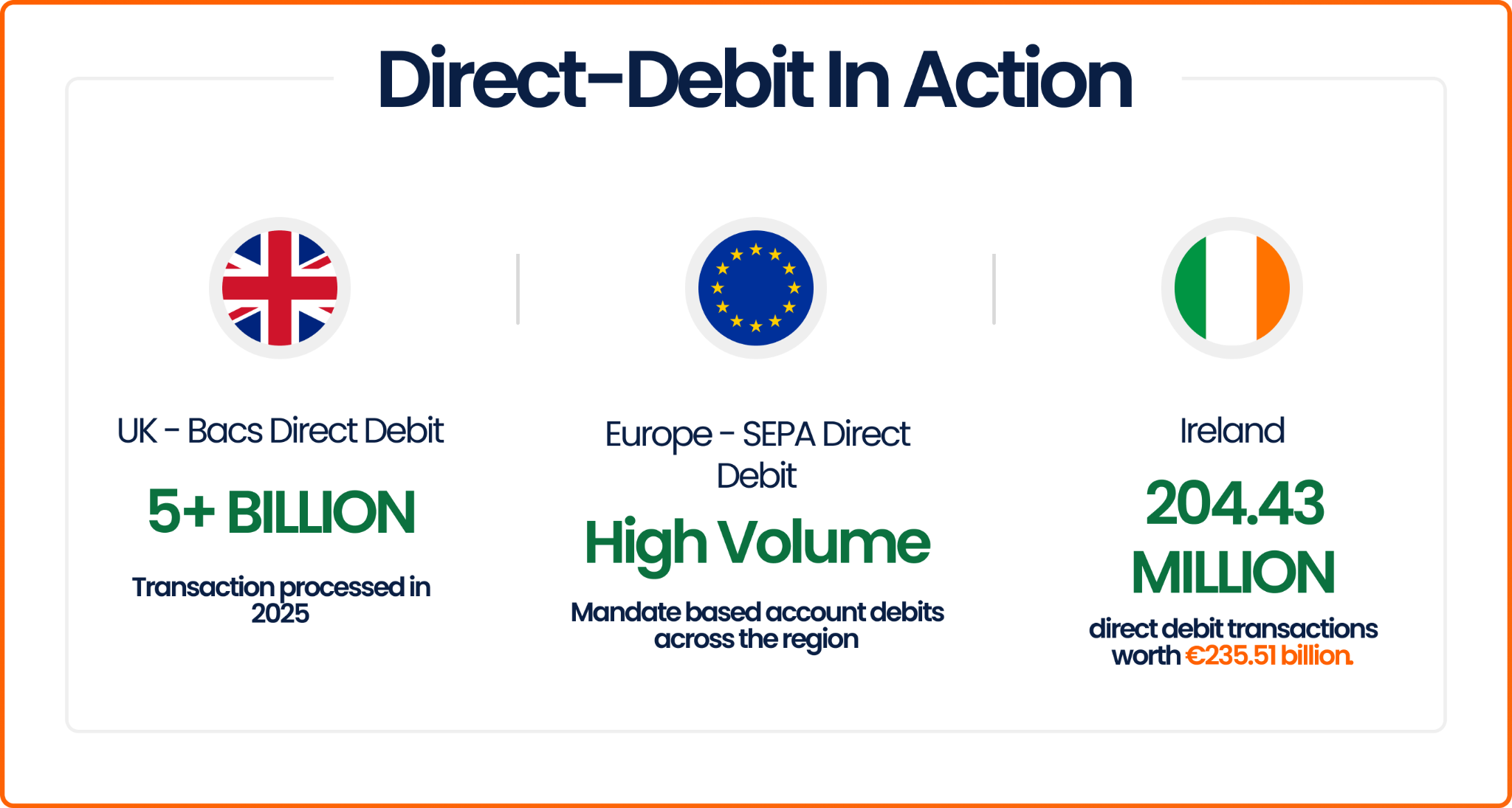
This is why direct debit has become a core part of mature payment systems in markets where recurring payments are deeply embedded. In the UK, Bacs Direct Debit processed over 5 billion transactions in 2025, supporting use cases across household bills, subscriptions, insurance, credit and business payments. Across Europe, SEPA Direct Debit continues to support large volumes of mandate-based account debits, while Ireland’s payment statistics show direct debit remaining a significant part of recurring payment activity, with 204.43 million direct debit transactions worth €235.51 billion.
The point is not that Nigeria should copy these markets blindly. The point is that as economies mature, recurring obligations need payment rails that are built for consent, scheduling, reliability, reconciliation and recovery.
The Nigerian Direct Debit Opportunity
Nigeria already has the foundation for this through NIBSS Direct Debit. NIBSS describes NDD as a platform for mandate instructions and automated bank account debits, with functionality across user management, mandate management, transaction management, report management and billing management.
The service supports institutions such as banks, OFIs, MMOs, fintechs, PSSPs, pension companies, insurance providers, credit companies, service businesses and utility companies. It also supports fixed mandates, variable mandates and partial debits, which makes it useful beyond simple subscription collections.
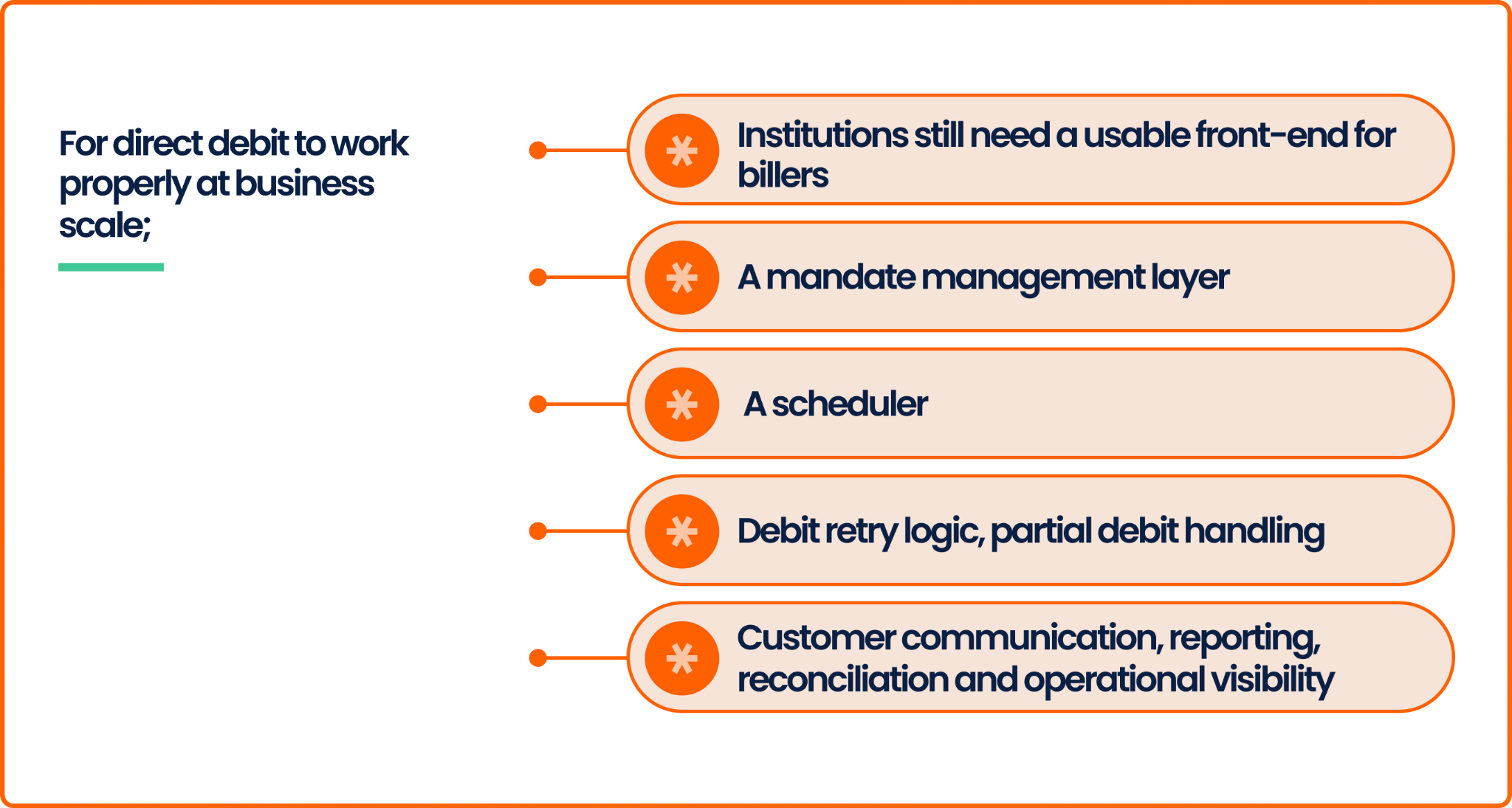
However, access to the rail is only one part of the problem. For direct debit to work properly at business scale, institutions still need a usable front-end for billers, a mandate management layer, a scheduler, transaction monitoring, debit retry logic, partial debit handling, customer communication, reporting, reconciliation and operational visibility. NIBSS itself notes that institutions require a front-end for billers, a scheduler and the relevant NIBSS APIs to build the service.
That is where the real implementation work begins.
What Assurdly Has Built
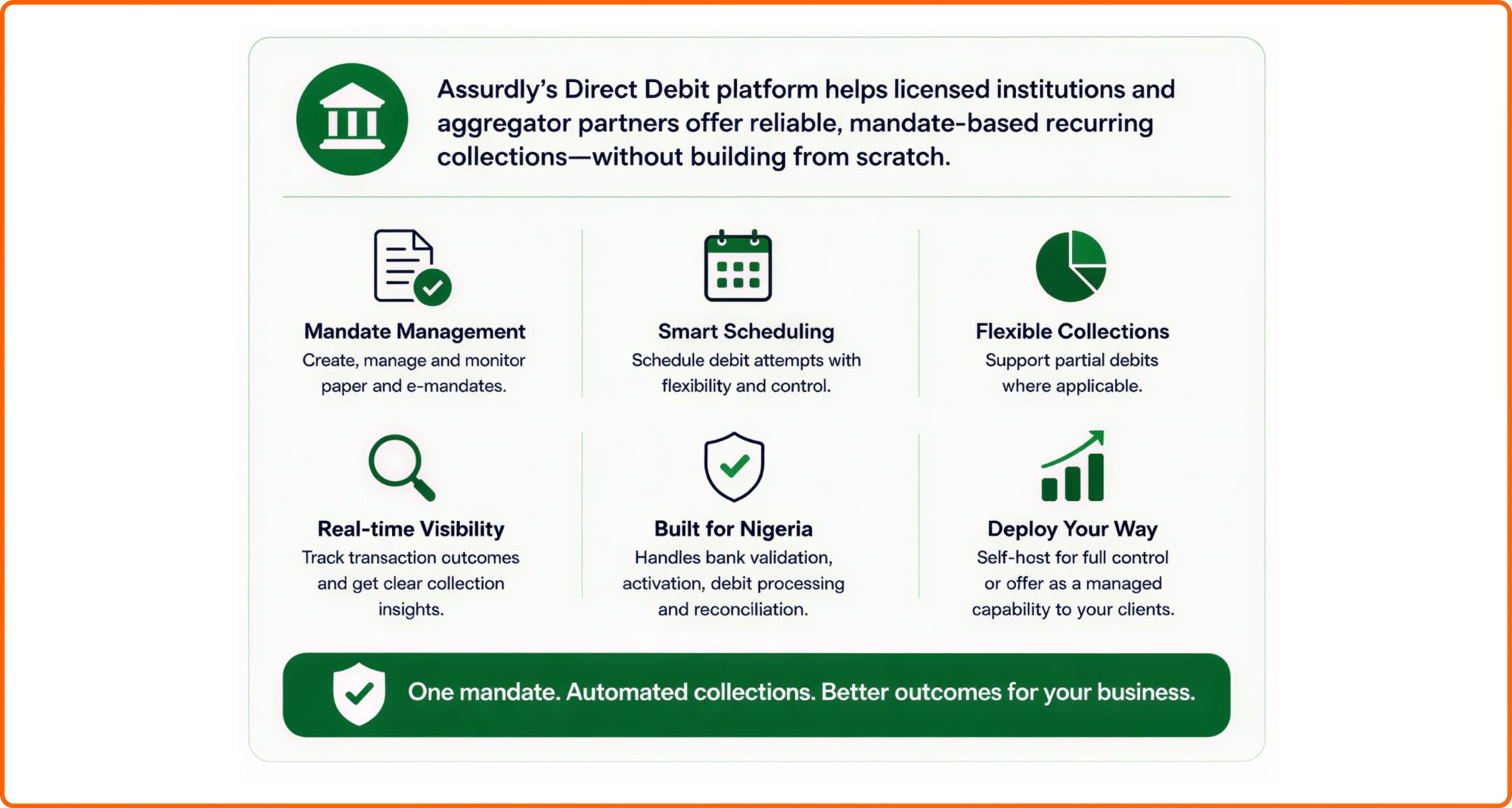
Assurdly’s Direct Debit platform was built to simplify this layer for licensed institutions and aggregator partners that want to offer reliable account-to-account recurring collections without starting from scratch.
The platform allows businesses to create, manage and monitor mandates, schedule debit attempts, support partial debits where applicable, track transaction outcomes and give billers clearer visibility into their collections. It builds on the practical realities of direct debit implementation in Nigeria, where paper mandates, e-mandates, bank validation, customer activation, debit scheduling, transaction status and reconciliation must all be handled properly for the service to work in production.
As explained in our earlier article on Direct Debit as an account-to-account payment option, Direct Debit allows businesses to collect payments directly from a customer’s bank account with prior authorisation, removing the need to manually chase customers for every recurring payment.
This distinction matters because the platform can support different operating models. For licensed institutions that want ownership, control and deeper operational alignment, it can be self-hosted within their infrastructure, giving them more control over deployment, data handling, internal workflows, customer experience and product expansion.
For aggregator partners, the platform can also be offered as a managed direct debit capability to other businesses. This means an aggregator can onboard billers, support different collection use cases and build a recurring revenue product on top of an already structured direct debit engine, rather than treating direct debit as a one-off integration.
Where Direct Debit Creates Business Value
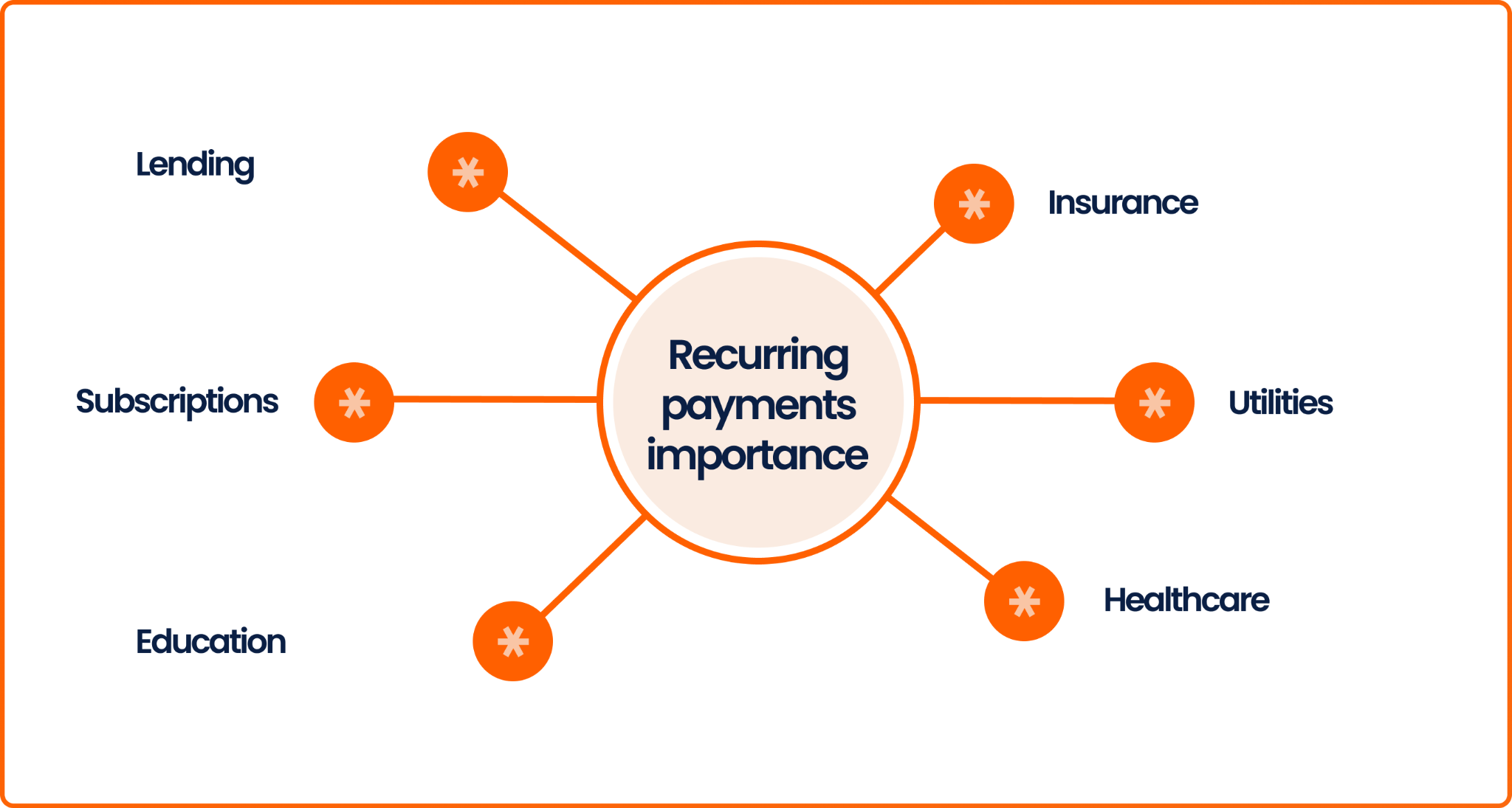
The strongest use cases are found wherever payment is expected more than once. Lenders can use direct debit to improve repayment collection and support partial recovery where the full debit amount is unavailable. Insurance providers can collect recurring premiums more reliably. Savings and investment platforms can automate customer contributions. Property and rent businesses can structure scheduled payments, while utility providers, schools, cooperatives, subscription businesses, healthcare providers and service platforms can reduce manual follow-up and improve cash flow visibility.
The benefit is not only automation. The deeper value is predictability because a business that can see its active mandates, expected collections, successful debits, failed attempts, partial debits and recovery pipeline is operating with better information than one waiting for customers to remember to transfer money.
From Payment Collection To Payment Infrastructure
Direct debit should not be treated as just another payment option on a checkout page. It is a collection infrastructure for businesses that need recurring, consent-based account debits.
As Nigeria’s digital economy continues to expand, recurring payments will become more important across lending, insurance, subscriptions, utilities, education, healthcare, savings, rent and business services. The companies that solve collection reliability early will have stronger cashflow, better customer management and more disciplined operations.
Assurdly’s Direct Debit platform exists for that layer. It gives licensed institutions and aggregator partners a structured way to offer mandate-based recurring payments, either as a self-hosted capability within their own environment or as a managed platform they can extend to the businesses they serve.
When recurring payments matter, the question is no longer whether customers can pay. It is whether the business has the infrastructure to collect reliably when payment is due, understand what has happened when a debit fails and keep revenue moving with less operational friction.