Recurring payments are only useful when they actually recur.
For many Nigerian businesses, that is where the gap begins. A customer may have agreed to a repayment plan, subscription, insurance premium, savings contribution, rent schedule or service contract, but the business still has to deal with failed collections, manual reminders, customer follow-up, reconciliation delays and uncertainty around when the money will actually come in.
Cards and direct debit can both support recurring payments, but they do not behave the same way. For businesses that depend on predictable collections, the difference is important because the payment method affects control, failure rates, fraud exposure, mandate management and the overall cost of running the collection process.
The Basic Difference
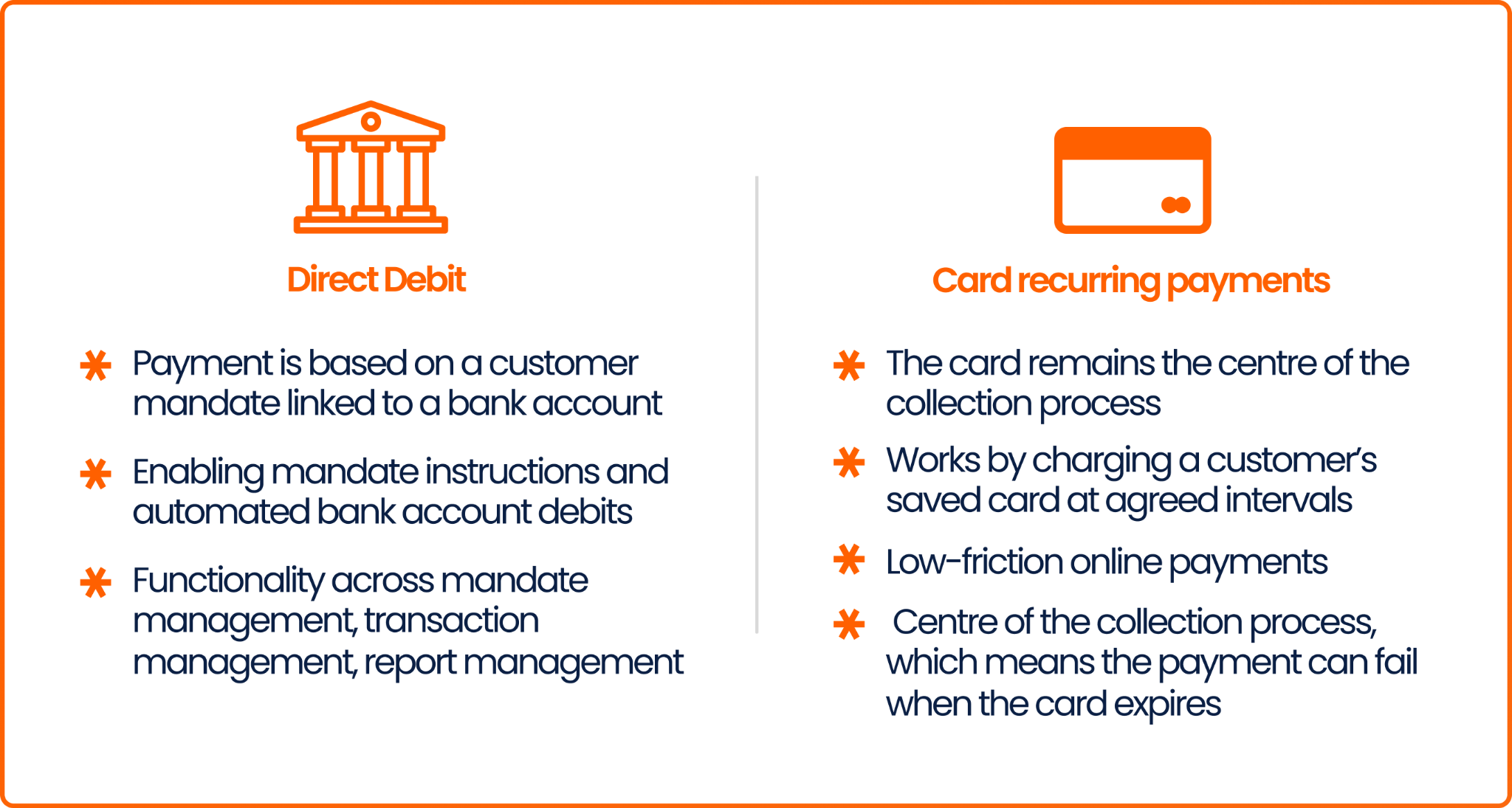
Card recurring payments work by charging a customer’s saved card at agreed intervals. This is familiar, easy to understand and useful for many digital businesses, especially where customers are making low-friction online payments. However, the card remains the centre of the collection process, which means the payment can fail when the card expires, is replaced, is blocked, hits a limit, requires authentication or becomes unavailable for reasons outside the business’s control.
Direct debit works differently because the payment is based on a customer mandate linked to a bank account. Once the customer gives authorisation, the business can collect from the customer’s account based on the approved amount, frequency and mandate rules. In Nigeria, NIBSS Direct Debit provides this foundation by enabling mandate instructions and automated bank account debits, with functionality across mandate management, transaction management, report management and billing management.
The difference is not just technical. Cards are designed around payment attempts, while direct debit is designed around authorised collection.
Control: Who Holds The Collection Advantage?
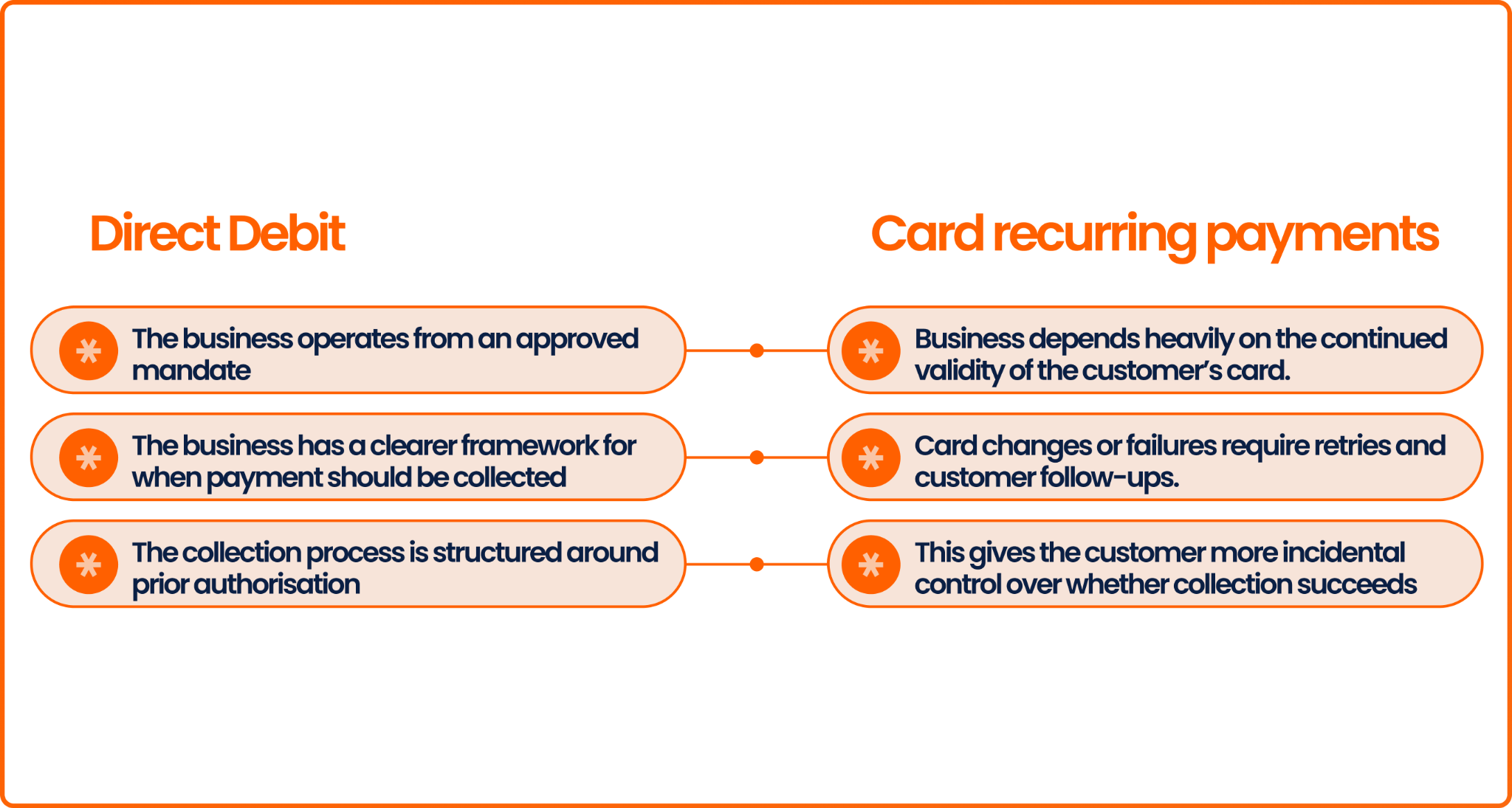
With card recurring payments, the business depends heavily on the continued validity of the customer’s card. If the card changes, expires or fails, the business has to recover the payment through retries, customer communication or an alternative payment method. This gives the customer more incidental control over whether collection succeeds, even where the customer has not deliberately refused to pay.
With direct debit, the business operates from an approved mandate. The customer still gives consent and the collection must follow the approved terms, but the business has a clearer framework for when payment should be collected, how much should be collected and what happens when a debit attempt does not fully succeed. This is especially useful for lenders, insurers, cooperatives, schools, utility companies and other businesses where payment obligations are tied to an agreed schedule.
This does not mean direct debit removes customer protection. It means the collection process is structured around prior authorisation rather than repeated customer action.
Failure Rate: Why Cards Break More Easily
Card recurring payments can fail for several reasons that have nothing to do with whether the customer wants to continue the service. Expired cards, lost cards, replaced cards, issuer blocks, insufficient card limits, authentication issues and fraud controls can all interrupt recurring charges. Adyen notes that lost and expired cards are a known cause of failed recurring payments and involuntary churn, particularly for subscription businesses where customers may not intend to leave but the payment method fails.
Direct debit is generally more stable for recurring collections because bank accounts do not expire in the same way cards do. The mandate can remain active for the duration of the customer relationship, subject to the approved rules and any cancellation or revocation process. This makes it better suited for businesses that need continuity across months or years, rather than businesses that only need a convenient way to charge a card.
That said, direct debit is not failure-proof. A debit can still fail if the customer has insufficient funds, the mandate is inactive, the account cannot be debited or the collection instruction does not meet the required rules. The advantage is that these failures sit within a more structured mandate and transaction lifecycle, making them easier to track, report, retry and reconcile.
Fraud Exposure: Card Details Vs Mandate Authorisation
Card recurring payments expose businesses to card-related risks because the collection process depends on card credentials. If card details are compromised, misused or disputed, the business may have to manage fraud claims, chargebacks and customer trust issues. This is one reason card payments require strong fraud monitoring, tokenisation, authentication and dispute management.
Direct debit changes the risk profile because the collection is based on a customer-authorised mandate rather than repeated use of card credentials. In direct debit schemes, the mandate becomes the basis for collection, with the customer’s authorisation, account details and approved payment structure forming the control layer. The European Payments Council describes SEPA Direct Debit as a model where the payer signs a mandate prepared by the biller, allowing the biller to request payment with prior approval.
For Nigeria, the principle is similar even though the local rules and infrastructure are different. The important thing is that direct debit moves recurring collection away from saved card dependency and into mandate-based authorisation, which gives institutions a clearer control point for consent, collection and auditability.
Mandate Lifecycle: The Real Operational Difference
The biggest difference between both models is not seen at the first payment. It becomes clear over the full customer lifecycle.
With card recurring, the business mainly manages payment attempts. The card is saved, the charge is attempted, and if it fails, the business retries or contacts the customer. This may work for simple subscriptions, but it becomes limited when the business needs stronger visibility into authorisation, collection schedules, partial payments, failed debits, recovery attempts and reporting.
With direct debit, the business manages a mandate lifecycle. That lifecycle begins with customer authorisation, continues through mandate activation, scheduled debit attempts, transaction monitoring, exception handling, partial debit where applicable, cancellation or expiry, and reconciliation. NIBSS Direct Debit supports mandate management and transaction management as part of its service structure, which is why businesses building on the rail still need a usable platform layer around it.
This is where Assurdly’s Direct Debit platform sits. As explained in our earlier article on Direct Debit as an account-to-account payment option, the value is not only that a business can debit a customer’s account. The value is that the business can manage the process properly across mandate creation, debit scheduling, transaction tracking and operational visibility.
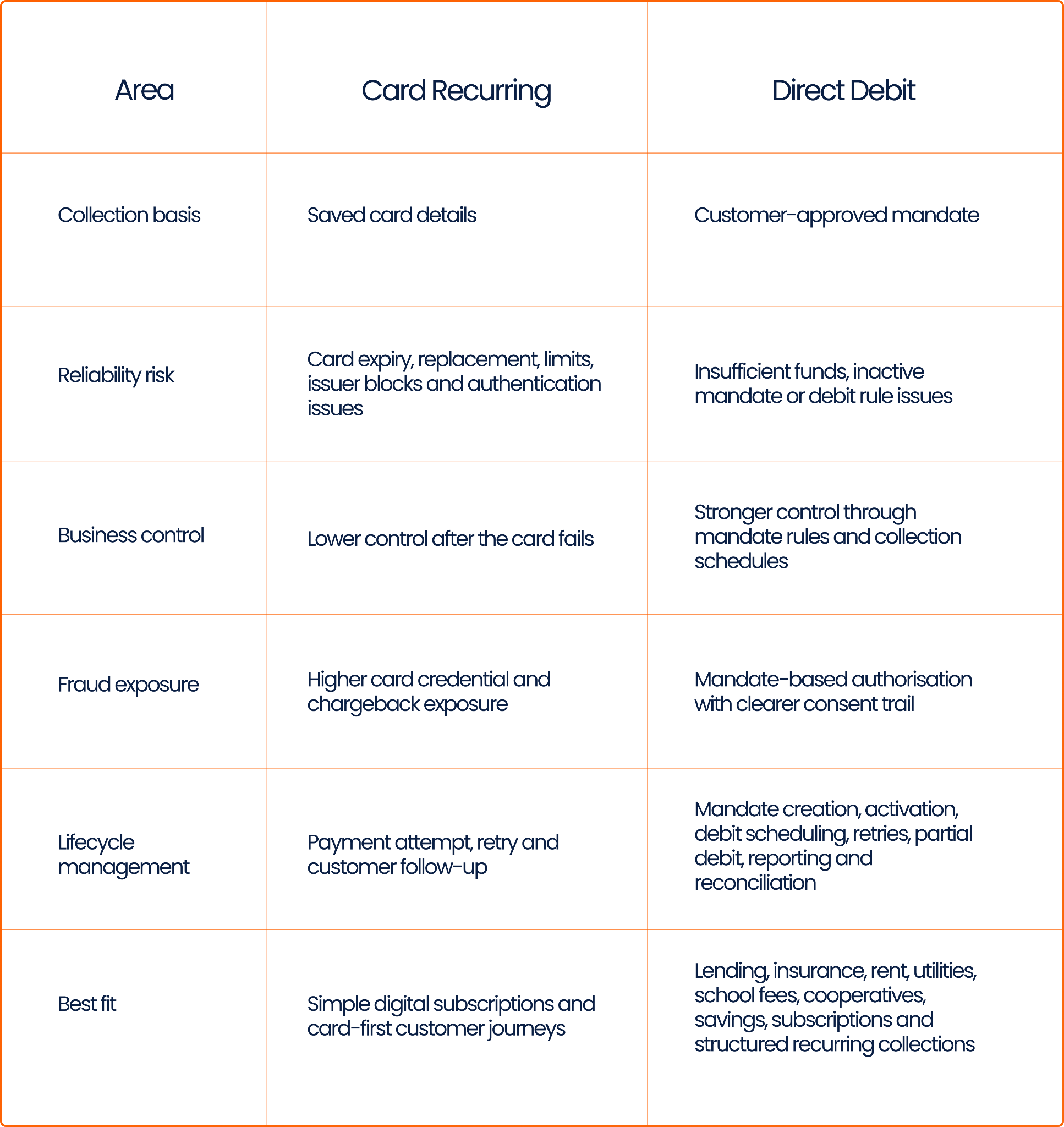
Side-By-Side View
Which Is More Reliable?
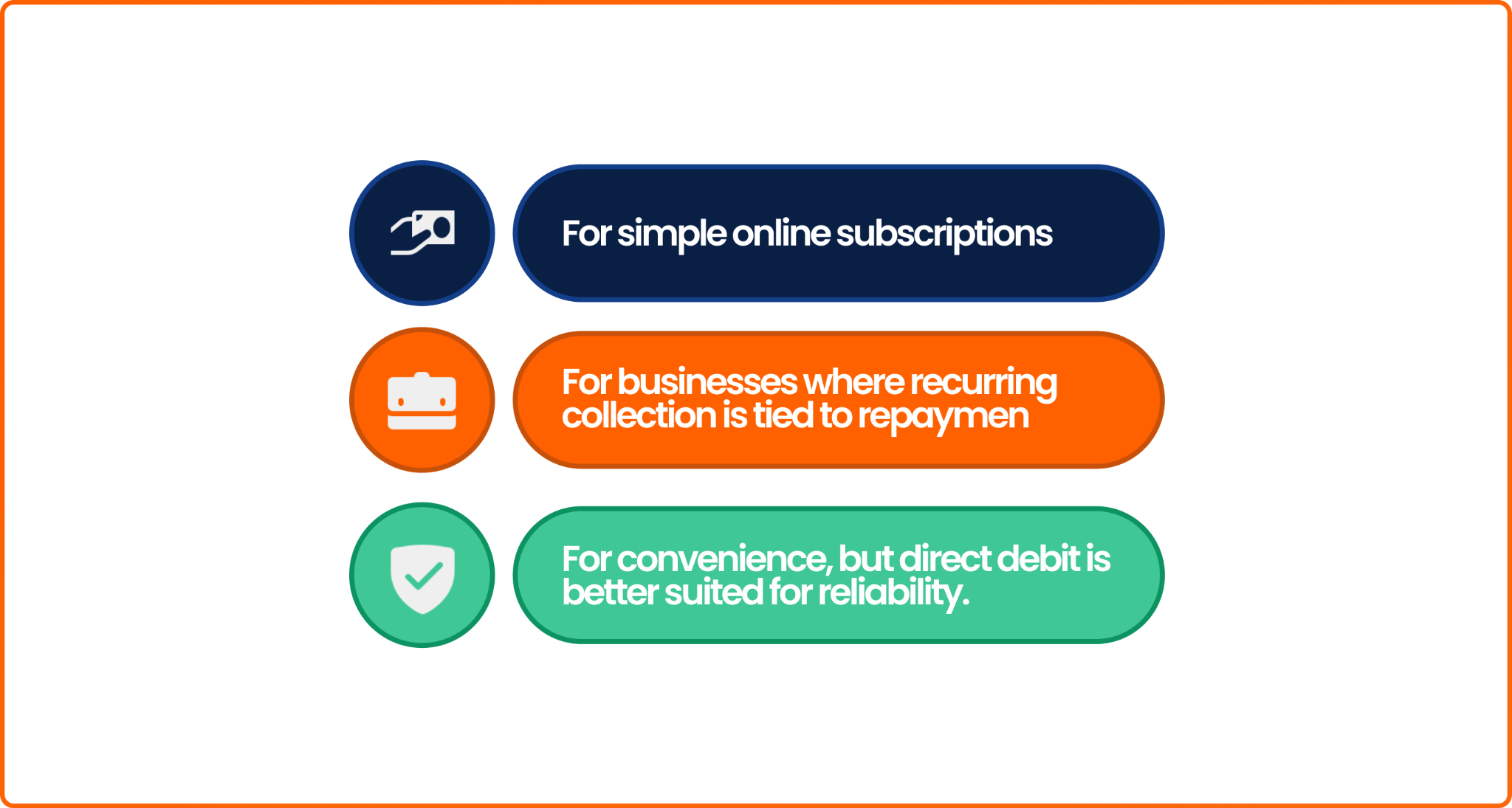
For simple online subscriptions where customers are used to paying by card and the business can tolerate some failed payments, card recurring may be enough. It is familiar, fast to start with and easy to understand.
For businesses where recurring collection is tied to repayment, premiums, contributions, bills or other scheduled obligations, direct debit is usually the stronger model. It gives the business a more stable collection structure, better mandate visibility and a clearer way to manage what happens after a payment fails.
The practical answer is that cards are useful for convenience, but direct debit is better suited for reliability. One is built around charging a payment instrument repeatedly, while the other is built around collecting against an authorised mandate.
For Nigerian businesses that depend on recurring revenue, that difference matters. The more predictable the collection process becomes, the easier it is to manage cashflow, reduce manual follow-up, improve recovery and build a more disciplined revenue operation.